
Today I’ve got a ground fighting flow drill you can use to practice several key elements of ground fighting.
If you haven’t already watched my videos on overhooks, scarf hold part 1, or scarf hold part 2 you might want to watch them first as this drill uses all of those technique pointers.
Why Ground Fighting Flow Drills?
In my experience most traditional martial arts schools focus on technique and forms while most sport schools focus on just sparring. The technique schools never learn how to fight and the sparring schools build tons of bad habits and progress is stagnated.
Using a drill such as a ground fighting flow drill allows you to focus on technique in a recreated fight-like scenario. You can dial up or down the amount of resistance that you give to your partner which allows them to stay focused on good technique while under a progressive level of pressure.
With any new drill start by giving your partner zero resistance and allow them (and yourself) to learn the pattern while staying emotionally calm. Then slowly start adding in some level of resistance such as punches, trying to escape, etc.
Obviously on some level if you make it like complete sparring you must abandon the drill since you and your partner will know what the next person’s move is. So rather than progressing to complete sparring progress where you force your training partner to do the drill with correct technique or it won’t work.
For instance if they are going to roll you over but always forget to trap your hand then reach out and stop the roll. This will provide amazing feedback to remind them to trap your hand.
Flow Drill Roles – Winner / Coach (Attacker)
During this drill there is a winner – that is the person who is learning to get better. The other person assumes the role of the coach / attacker. The role of the coach / attacker is to simulate the attacker of course but more importantly to be a coach.
As mentioned previously the coach will dial up or down on the resistance in order to make sure that the winner is both successful and challenged. If the winner is floundering then the coach is using too much pressure and needs to dial down. You don’t learn when you are just surviving. The goal is for the winner to be able to build up over time to high levels of pressure (speed, resistance, punches, thrown, etc.) without losing form and while staying calm and relaxed.
So the most important person is the coach.
Ground Fighting Drill
So you really will need to watch the video to get the full details but here are the basic steps along with some photos for reference.
- The winner starts on their back
- The coach starts off to the side and enters throwing punches
- The winner shrimps to a shin guard position while attaining double overhooks
- The winner will roll the coach and then transition to the side mount just long enough to move into a scarf hold – once again many of these moves have been shown in previous videos / articles
- The winner will then terminate the fight using elbows, joint locks / wrenches, etc.
- Now the winner and coach switch roles. The person in the scarf hold becomes the winner. You with me on this?
- The new winner then does an escape from the scarf hold and assumes a side mount
- The new winner will then step over into a kneeling side mount, trap the arms of the new coach and terminate with a series of hammer fists to the head
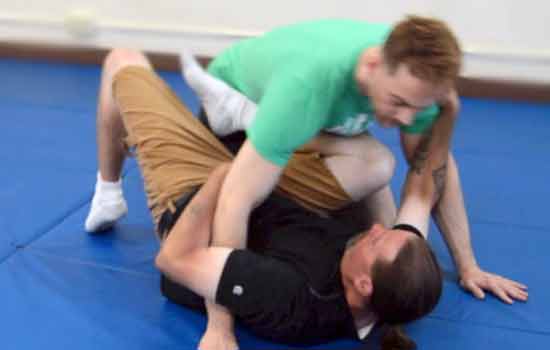
When shrimping to a shin guard always go after the overhooks at the same time. You must do this drill till multitasking is natural.
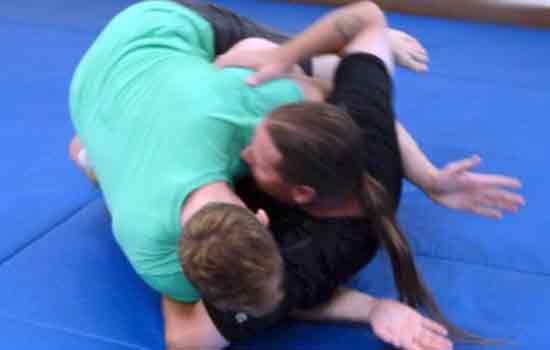
If you are new to rolling people keep the following pointers in mind:
- If their body weight is far away from you they will feel heavy. So use your overhooks to pull them up high towards your head. Now their weight is resting on you making them lighter and easier to roll.
- Most people use the wrong muscles to roll with. The best way I can describe the motion is to simply lie on your back, point your right knee to the ceiling, now put your right knee on the ground on the left side of your body. Don’t overthink it. Practice till this is natural.
- Go with their momentum so you don’t fall back to your back. But don’t over roll or you might just keep rolling and wind up on your back on the other side. Stop your momentum once you can. Staying low helps to not get immediately rolled again.
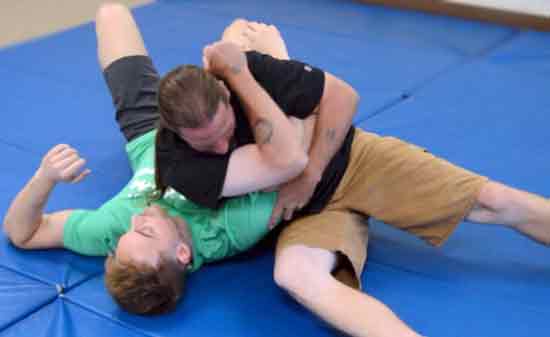
Flow into the scarf hold and practice all of your terminations.
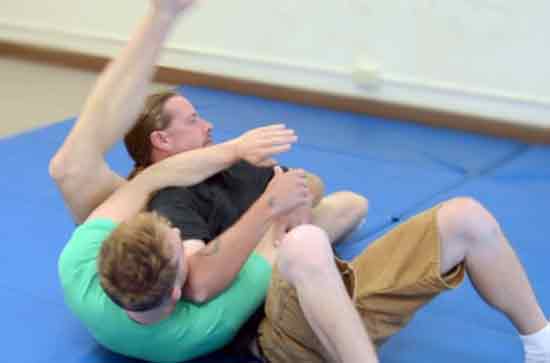
We have now switched roles. I was the coach / attacker (green shirt) but now I will be the winner.
I’ll use a simple arm and leg hook escape. Then I’ll get to a side mount before transitioning into a kneeling position.
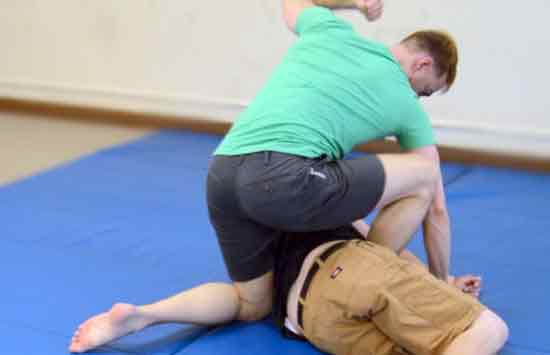
I’ve got my knee dug into their back and my heel dug into their gut. This locks them in and prevents them from rolling towards me to escape.
In this position it is very difficult for someone to fight back.
You can see my right arm is holding down their right arm. I am literally holding my partner’s top arm on top of their bottom arm. This makes it so I can hold both arms with only one of mine leaving the other free to hit with. This isn’t some sort of permanent hold on the arms but it will give you enough time to end the fight with rapid strikes.
Speaking of rapid strikes I recommend hammer fists so you don’t break your knuckles and wind up with a boxer’s fracture. Use the meaty padding on the base of your hammer fist not the knuckle side.
At this point we would repeat the drill switching who starts off on their back.
Final Thoughts
Easy peasy lemon squeezy. This drill will teach you how to navigate some common ground fighting positions and also will teach you how to terminate the fight quickly. It is modifiable for sports, self-defense, law enforcement, military, etc. Just change your terminations and equipment to suit what you would have access to and what would be legal.
Until next time,
Brian


